This population needs to be shipped off to the factories and the fields.

This population needs to be shipped off to the factories and the fields.


Bring back the cult of work.

We have 11.76 million teenagers 16-19 years old, 7.45 million college kids 20-24 years old, 25.89 million core adults 25-54 years old, and 67.63 million people 55 or older, all of whom did not work in August 2026.
That's over 112 million eating but not working.
They can't all work, obviously, but if each group lived up to its own past peak performance, 13.27 million more across all groups could in fact be working who are not working.
That 13.27 million more working is just 11.8% more.
GDP sucks in part because we aren't working up to our past potential.
As I incessantly point out, the key to a happy life is a full time job, because it allows you to arbitrage it for a car, a home, a spouse, and children.
Peak full time in America was in July 2000 when 54.67% had a full time job. In August 2026 just 49.14% did. The difference between those two points at current population is an extra 15.2 million full time jobs which we don't presently have.
America is a much bigger place now than in July 2000, too, by 63 million in civilian non-institutional population. Shouldn't that also make us stronger?
Do we really think an extra 15 million out of 112 million is dreaming the impossible dream?
We need leaders who don't think so.
But this guy . . .


Over 112 million, that's who:
67.2% of teenagers 16-19 years old: 11.8 million
33.7% of the college-aged 20-24 years old: 7.5 million
19.9% of prime working age adults 25-54 years old: 25.9 million
64.1% of the population 55 years old or older: 67.6 million.
Get a haircut and get a real jobClean your act up and don't be a slobGet it together like your big brother BobWhy don't you, get a haircut and get a real job?
-- George Thorogood, 1993

It's not a perfect one to one comparison, let alone an actual measurement, but about 20% of teenagers worked in 1979, and not quite 12% today:


 |
| 16 to 19 |
 |
| 20 to 24 |
 |
| 25 to 54 |
 |
| 55 and over |
 |
| 65 and over (subset) |

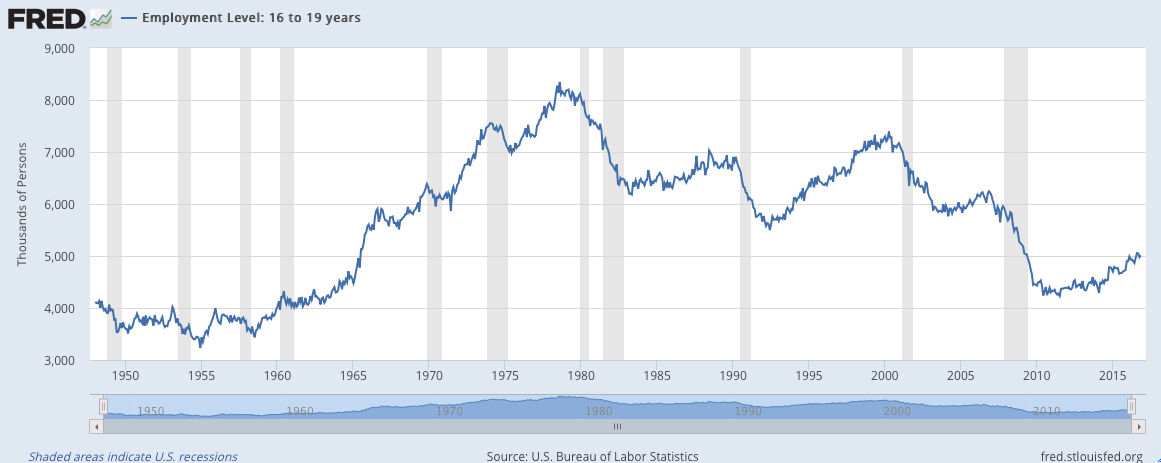 |
| 3.3 million fewer teens work in 2016 than in 1978 even though |
 |
| the size of this population in 2016 is the same as in the late '70s |

